

Most homeschool parents know they should keep records. What many don’t know is which records actually matter, why they matter, or when they’ll need them.
It’s easy to assume record keeping is primarily about satisfying your state’s homeschool requirements. While legal documentation is certainly important, good record keeping serves a much bigger purpose. It becomes the foundation for nearly every major document you’ll create during your student’s high school years and beyond.
Your transcript. Course descriptions. Scholarship applications. College applications. Letters of recommendation. Activity lists.
All of these rely on information you’ve collected over time.
The challenge is that you rarely know today what you’ll wish you had documented three years from now. Volunteer hours that seemed insignificant as a freshman may become part of a scholarship application as a senior. A reading list you never thought to save could help you write a detailed course description later. An award certificate tucked into a drawer may become valuable evidence of your student’s accomplishments.
That’s why the best time to build a record-keeping system is before you need it.
The good news is that it doesn’t have to be complicated. In fact, the simplest systems are often the ones families stick with year after year.
Why Record Keeping Matters More Than Most Families Realize
Many parents think of record keeping as an administrative task; a necessary chore that comes with homeschooling. While this is definitely true, in reality, it’s much more than that.
Good records create the evidence behind your student’s education.
When it’s time to prepare a transcript, you’re not trying to remember which science curriculum your student used two years ago. When a college application asks for volunteer activities, you’re not estimating dates or hours from memory. When you’re writing a course description, you’re not flipping through old boxes hoping to find a project your student completed. Instead, you’re simply organizing information you’ve already collected.
That’s an important shift in perspective. Record keeping isn’t about creating paperwork for paperwork’s sake. It’s about preserving information while it’s accurate and easy to find.
Throughout high school, your records may support:
- Creating an accurate homeschool transcript
- Writing detailed course descriptions
- Completing college and scholarship applications
- Documenting extracurricular activities and leadership
- Tracking volunteer service and work experience
- Preparing counselor recommendations
- Meeting state homeschool documentation requirements
- Building a portfolio if one is requested
Though you may never use every record you save, when you do need something, you’ll be glad you have it.
The Biggest Misconception About Homeschool Records
One of the most common assumptions parents make is:
“We’ll organize everything during senior year.”
It sounds reasonable. After all, college applications don’t happen until the end of high school, so why worry about record keeping now?
The problem is that memory fades. I don’t know about you, but I can barely remember what I had for lunch yesterday, let alone what assignments my daughter completed in World Geography. Heck, a year from now, I might not even remember that I wrote this article!
By senior year, it’s surprisingly difficult to remember:
- Which textbooks were used in ninth grade
- When volunteer activities took place
- How many hours a student worked each week
- Which books were assigned versus independently read
- The names of competitions, camps, or enrichment programs
- Dates for awards and accomplishments
Trying to recreate four years of records from memory is time-consuming, frustrating, and often incomplete. A much better approach is to collect information gradually as your student moves through high school.
Think of record keeping as taking snapshots along the way instead of trying to recreate the entire journey at the finish line.
Just a few minutes of organization each month can save dozens of hours later.
What Records Should You Keep?
One of the biggest mistakes families make is assuming they need to save everything. You don’t (thank goodness, right?). If you’d rather keep this information organized in one place, the High School Record Keeper gives you a simple system for tracking the academic records, activities, achievements, testing, and other details you’ll want to have later.
Keeping every worksheet, quiz, and rough draft quickly becomes overwhelming and usually isn’t necessary. Instead, focus on preserving the information that tells the story of your student’s education.
Academic Records
Your academic records form the backbone of your student’s high school documentation.
At a minimum, consider keeping:
- Course titles
- Credits earned
- Final grades
- Curriculum or textbooks used
- Reading lists
- Major projects and research papers
- Significant lab reports
- Writing samples
- Course completion dates
Notice that this isn’t just a collection of grades.
These records help answer questions that often arise later, such as:
What exactly did this course include? How rigorous was the curriculum? What evidence supports the credit awarded?
Most colleges won’t ask to see every assignment your student completed. However, having representative work and basic course documentation makes it much easier to prepare transcripts and course descriptions if they’re ever requested.
Think of these records as preserving the highlights rather than every step along the way.
Activities, Leadership, and Life Experience
One advantage homeschool students often have is the flexibility to pursue meaningful experiences beyond traditional classrooms. It’s a big reason why some of us choose to homeschool to begin with. Those experiences deserve to be documented.
Keep records of activities such as:
- Volunteer service
- Employment
- Internships
- Entrepreneurship or small businesses
- Music, theater, or visual arts
- Athletics and recreational sports
- Clubs and organizations
- Church leadership
- Debate or speech competitions
- Scouting
- Academic competitions
- Community involvement
Don’t overlook responsibilities that demonstrate maturity, leadership, or initiative simply because they weren’t school-sponsored.
For example, managing a family business’s social media, organizing community service projects, teaching younger siblings in a structured setting, or maintaining long-term employment may all reflect qualities colleges value.
As you document these activities, record more than just participation. Whenever possible, include:
- Dates
- Estimated hours
- Leadership roles
- Awards or recognition
- Major accomplishments
- Responsibilities
Awards, Honors, and Certifications
Achievements have a way of accumulating over four years. Unfortunately, they also have a way of disappearing.
Save copies of certificates, award letters, competition results, and any documentation recognizing your student’s accomplishments. This might include:
- Academic awards
- Honor societies
- Competition placements
- Scholarships
- Industry certifications
- CPR or first aid certification
- Microsoft Office, Adobe, or technology certifications
- Foreign language proficiency
- Music examinations
- Athletic recognitions
Even if an award doesn’t ultimately appear on a college application, keeping accurate records ensures you’ll have the information available if it’s ever needed.
More importantly, collecting these items in one place helps you build a complete picture of your student’s high school experience rather than relying on memory when application season arrives.
Testing Records
Standardized testing is only one part of the college admissions process, but it’s still worth keeping organized records of any exams your student takes.
This may include:
- PSAT/NMSQT
- SAT
- ACT
- CLT
- AP exams
- CLEP exams
- Dual enrollment transcripts
- Placement tests or other standardized assessments
In addition to saving score reports, make note of the testing date and any superscores or updated results if your student tests more than once.
Not every college requires standardized test scores, and many have adopted test-optional admissions policies. However, some colleges, scholarship programs, honors colleges, and state universities still consider them during the admissions or scholarship process.
Having organized records means you won’t be scrambling to locate score reports months (or even years) after the exams were taken.
College Planning Records
By the time students reach junior and senior year, college planning generates its own collection of documents. Many families don’t think to organize these until applications are already underway. Instead, consider creating a dedicated place to keep information such as:
- Colleges your student is considering
- Campus visit notes (before all tours start to look and feel the same)
- Admissions contact information
- Application deadlines
- Scholarship opportunities
- Financial aid information
- Essay ideas and prompts
- Recommendation letter requests
- Application login information
Keeping these records together won’t make college admissions less work, but it will make the process significantly easier to manage. Rather than searching through emails, notebooks, and browser bookmarks, you’ll know exactly where to find the information you need.
Paper, Digital, or Both?
There isn’t one right way to organize homeschool records.
Some families prefer binders and filing cabinets; the ability to physically touch and mark a piece of paper, knowing exactly where to find it when needed. Others keep everything digitally. Many use a combination of both.
The important thing isn’t the format. It’s consistency.
Digital systems have several advantages. They’re searchable, easy to back up, and don’t require boxes of storage space. Paper copies, however, can still be useful for original certificates, handwritten work, or documents that are difficult to scan.
Whatever system you choose, aim for one central location rather than storing information across multiple notebooks, folders, devices, and email accounts. When everything has a designated home, it’s much easier to keep records current.
Want a simpler way to keep everything organized?
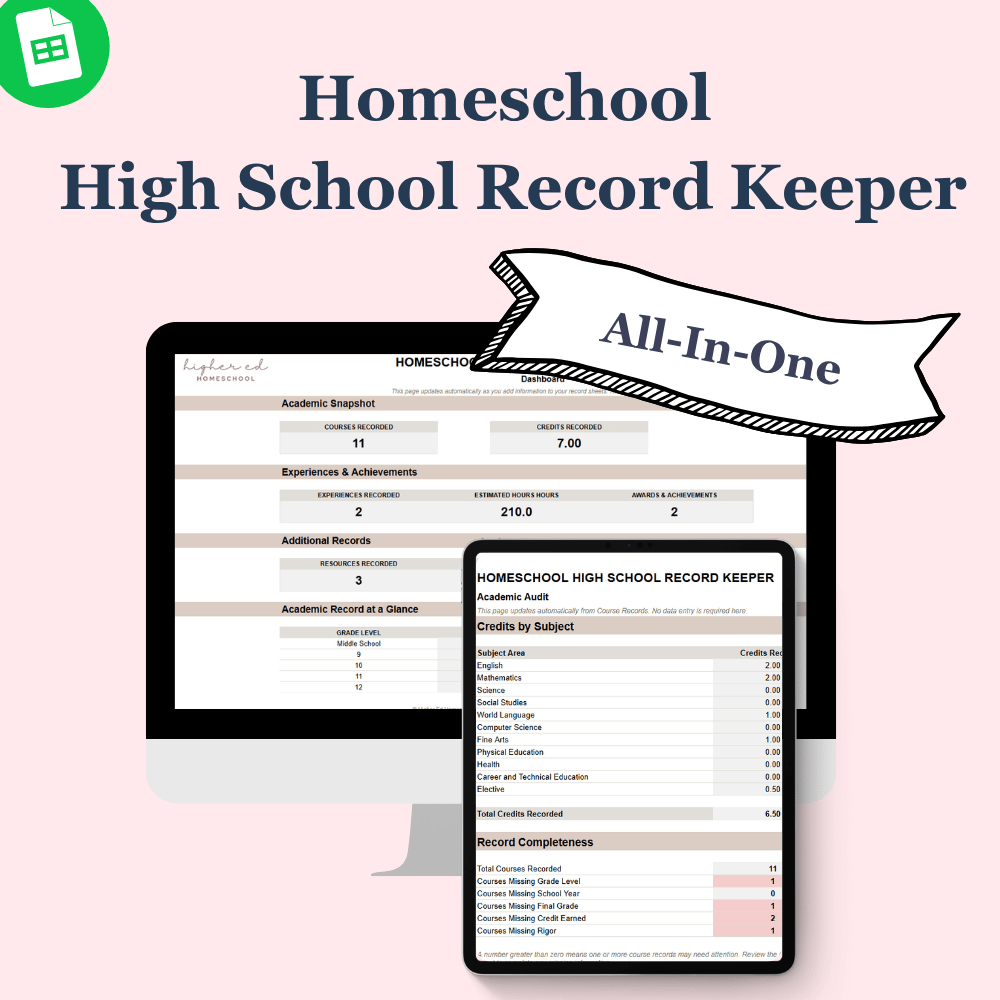
The High School Record Keeper is a Google Sheets system designed to help you track courses, credits, activities, awards, reading and resources, testing, and outside coursework throughout the high school years so the information you need later is already there when you need it.
How Often Should You Update Your Records?
One of the easiest ways to stay organized is to make record keeping part of your regular homeschool routine rather than a year-end project.
Take it from a former school teacher was 150 students at any given time: you don’t need to spend hours every week updating files.
Instead, consider breaking it into small, manageable checkpoints.
Weekly
Keep notes on activities, volunteer work, employment, or accomplishments while they’re still fresh in your mind.
Monthly
Save important documents, update activity logs, and file any certificates, awards, or major projects.
End of Each Semester
Record final grades, completed courses, curriculum used, and significant academic work.
End of Each School Year
Review everything you’ve collected.
Confirm that course information is complete, activity records are accurate, and important documents have been saved before beginning the next school year.
Spending a few minutes throughout the year is almost always easier than trying to reconstruct an entire year from memory. Because, no, you won’t remember things the way you think you will.
What Happens If You Don’t Keep Good Records?
Poor record keeping doesn’t automatically prevent a student from getting into college.
But it often creates unnecessary stress.
Families who wait until senior year frequently find themselves asking questions like:
“What curriculum did we use for Biology?” “How many volunteer hours did she complete?” “When did he start working?” “Where did we save that research paper?”
Sometimes the information can be reconstructed. But sometimes it can’t.
When records are incomplete, parents may end up estimating dates, forgetting accomplishments, or leaving valuable experiences off applications simply because they weren’t documented. You might be surprised by how much your kid can accomplish during their high school years.
Good record keeping isn’t about preparing for the worst. It’s about making sure your student’s hard work is remembered accurately when it matters most.
Record Keeping Isn’t About Perfection
If you’ve made it this far and are realizing you haven’t documented everything perfectly, don’t panic. Very few homeschool families have their i’s dotted and t’s crossed when it comes to consistently keeping good records.
The goal isn’t to create a flawless archive of every assignment, worksheet, and field trip, but to build a practical system you’ll actually use.
A simple spreadsheet that’s updated consistently is more valuable than an elaborate organizational system that’s abandoned after two months. Likewise, a folder containing representative work samples is usually far more useful than boxes filled with every piece of paper your student has ever completed.
Progress beats perfection.
Start where you are, improve your system over time, and focus on preserving the information that will be most valuable later.
Start Before High School (If You Can)
Although most official high school records begin in ninth grade, families with younger students can benefit from developing good record-keeping habits earlier.
Middle school is an excellent time to begin documenting:
- Volunteer service
- Extracurricular activities
- Competitions
- Reading interests
- Special projects
- Awards and recognitions
- Emerging career interests
In some cases, students may also complete legitimate high school-level coursework during middle school. When that happens, accurate records become even more important, since those courses may eventually appear on the high school transcript.
Even if none of these records are ever used directly for college admissions, building the habit of organized record keeping before high school makes the transition much smoother.
Frequently Asked Questions
Do I need to save every worksheet?
Nope. Focus on preserving representative work, major projects, important assessments, and records that document what your student learned. Saving everything usually creates more clutter than value.
How long should I keep homeschool records?
At a minimum, keep high school records until your student has completed the college admissions process. Many families choose to retain transcripts and supporting documentation indefinitely since they may be useful for future education, employment, or graduate school applications.
Should I keep digital copies of important documents?
Yes. Even if you prefer paper files, having digital backups protects against loss and makes documents much easier to access and share when needed.
What if we change curriculum during the year?
That’s perfectly normal. Simply document what was used and approximately when. Colleges are far more interested in what a student learned than whether one curriculum was used from beginning to end.
Will colleges ask to see all of these records?
Usually not. Most colleges rely primarily on the transcript and the rest of the application. However, having thorough records allows you to answer questions confidently, prepare course descriptions if requested, and document your student’s education accurately.
The Bottom Line
Homeschool record keeping isn’t about creating more paperwork. It’s about preserving the story of your student’s education while it’s happening.
When you consistently document courses, activities, accomplishments, and important milestones, you aren’t just staying organized, but are building the foundation for transcripts, applications, scholarships, and every other document that follows.
Regardless of what you see on MomTok, the best record-keeping system isn’t the most elaborate one. It’s the one you’ll actually maintain.
A few minutes of organization throughout the year can save hours of frustration later and help ensure that your student’s accomplishments are represented accurately when they matter most.
Ready to put a record-keeping system in place?
The High School Record Keeper gives you one organized place to keep the information you’ll need throughout high school – without building your own system from scratch.
Up Next
Keeping good records is only the first step. Eventually, those records need to be transformed into documents colleges can easily understand and evaluate. Next, read How Colleges Evaluate Homeschooled Applicants to learn what admissions offices look for – and how transcripts, coursework, activities, testing, and recommendations work together to tell your student’s academic story.